KÜNSTLERPORTRÄTS:
Kutlu Gurelli
| |
Zurück zur Biographie
Installations
Paintings
Performance "ROAD TO MUENSTER" 18th - 28th October 2002: Call for participation
Installations
Text by Kutlu Gurelli
I did work with with different media at the same time and the following pictures are from my exhibited paintings, sculptures and installations. So let me tell you more about those past works now.
"There"
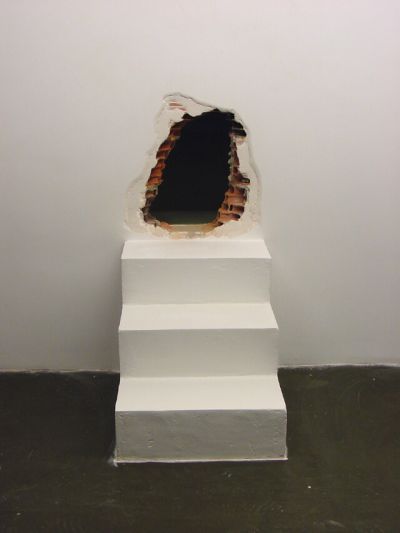
The name of the first work is "There", it consists of three steps and a hole in the gallery wall.
|
"There", 2001, ca. 120 cm height x 85 cm width
|
The hole opens to the back side of this space, to a corridor which has toilets at the end. Everyone who might need to go to there, experiences the work from the other side as well. That piece was exhibited at Proje4L/ istanbul contemporary art museum last year. Title / concept of the exhibition was "empathy". I came up with the impossibility of creating an empathy between "two". Adults centered "ergonomically" to indoor design is one of the further issues I have considered. Here I was highly influenced by a japanese shrine: At Kyoto/Japan inside this old and huge shrine supported with mass, long wooden blocks, there was a tiny hole at the bottom of one of the supports which was called "the gate to heaven". I have seen parents help their babies to go through this hole and guide them to heaven in a spiritual sense. In fact in Turkey we've got a similar traditional ritual at Hacibektas: every year people celebrate and pay tribute to Haci Bektas-i Veli. There is a rock with a crack on it and as the ritual goes, people try to get through that crack...it is believed that if you are pure and and free of sins, you can easily get through it, but many many got stuck there too …. With this in mind, I've tried to portray the agony caused by the conflict between our physical qualities and interior architecture's tools.
|
"11 pieces"
The next one - "11 pieces" - was done with my friend, Erdem Yücel.
|
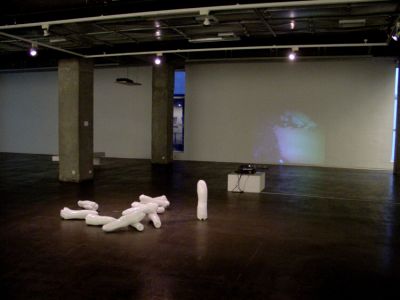
"11 pieces", 2000 / 2001, carved and painted plaster.
|
It consists of 11 pieces of carved plaster, painted white. There are 11 limbs like a small finger, below knee, tongue, breast, upper arm, penis, thumb..etc with some negative and positive roots at the tips, as if they were meant to plug into each other, (like LEGO). Their sizes are shifted and forced to one size, and that creates a great ambiguity and an uncanny situation. They all look like and are installed like toys being played with and left behind on the floor. I find the subject "fetishism" very interesting to study . That was one of the topics I once had in mind to write my thesis about - but I later found out what I really wanted to do...
|
Paintings
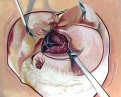
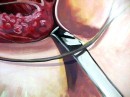
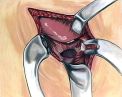
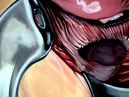
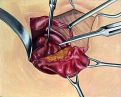
Another work is a triptych, I didn't name it, but it is not "untitled" since being "untitled" can be a title or something conscious about "being untitled"...
 | 
|
 | 
|
 |

| |
2001, each ca. 185cm x 135cm.
|
Details of each painting
|
There are three scenes from three different surgical operations. I was taking the "Ottoman culture through miniatures" class and preparing my term paper on the topic "Medical visualisation at the Ottoman miniatures". Throughout my research, I scanned a lot of medical illustrations and found the opportunity to consider their pictoral values and manners. During this process, I noticed some similarities between their manner and contemporary painting, for almost all examples of medical illustration, although there are sharp decisions being made to emphasize the content, do get beyond plain narrative visualisation and excessive features are muted (like blood, bodily liquids, some tissues and organs). After all, I've decided to paint large medical illustrations in a parallel manner, avoiding to paint skin with lots of values bringing the canvas' surface to the fore, like the role of skin, this emphasizes acceptance of the two-dimensional flatness of the medium. And surgery tools working on the wound can be easly read as a metaphor which refers to the spectator's gaze on the "work of art". The pre-prepared, clean, almost cute organs being cut and torn by shiny stainless steel creates its own further reading and content on a more conceptual basis.
|
"Fly, Lack of Buffalo"
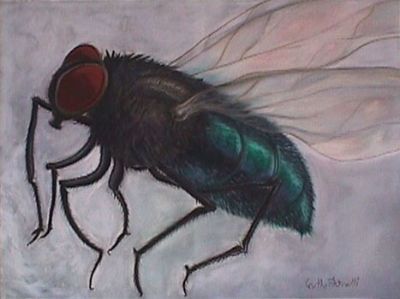
The painting called "fly" was my first exhibited painting. It was exhibited at the graduation exhibition of Gazi University. At the time, I was busy thinking about the effects caused by changing the size. It still sounds very exciting to me but I guess I am not working on such concepts anymore. I did paint this piece in a detailed but not realistic manner, anyway, let me get back to the story of this painting...
|
"Fly, Lack of Buffalo", 2001, ca. 185cm x 135cm.
|
I can't skip over one important fact which led me to do this painting: I really don't and didn't like Gazi University's education of Arts. In the last year of my studies, we were asked to paint for the graduation exhibition. My concept was "pests and insects" and I made up my mind contribute a protest painting: This green backed fly is known as "shit fly" in Turkish and when you see one of them, you can be sure that there is pooh or something dead around. Ironically enough: after the exhibition, Gazi University took this picture from me and hung it at the Gazi University's public hospital.
|
Performance 2002:
The performance will start around the 18th Oct and will end around the 28th Oct. The object is to reach the Academy of Fine Arts Muenster
at Nordhein-Westfalen via the highway from Ankara / Turkey.
Transportation will be by hitchhiking. The countries I will pass through in Eastern Europe are: Bulgaria, Romania, Hungary, Slovakia, and the Czech Republic, in an alternative path, I may bypass Slovakia and the Czech Republic. And pass through Austria. This 3000 km journey can be made non-stop within 2-3 days but due to my plan I will spend at least 1 day in each country.
About my position as an actor, the process of acting
and the act itself
There are two aspects of this scenario, one is my performance which will make me face the physical road/map and the other is its documentation which will reflect the cultural map. The cultural variety of Eastern Europe and the nature of the road as trade route point out some necessary concepts which are relevant to any act like this. Interaction between the road and its territory takes shape according to the use of the road. Truck pits, resting points, cheap hotels, drive-ins, 24/7 restaurants, and gas stations are some of the characteristics of this interaction. I will be conscious about this point; road shapes the culture of its territory.
At this point, there are some keywords and concepts, which occur to me, like
- being in the MIDDLE of
something, the road itself; is it nowhere or anywhere?
- the immigration of Turkish workers to Germany started
back in the 60's; the relation between these two different
cultures, the resistance between them
- De/re-territorialisation (in micro example; "me" and
in macro example; "immigrant Turks")
- And of course the
variety of such cultural blendings that have happened and are still happening
across Eastern Europe
There is a significant distance between me (while experiencing the reality) and the spectator. I find this very relevant to the discussion about the relations between performance and video installation. What ever is "projected" or by other words "mediated" becomes fictional. In that sense we can define the two aspects of the performance as non-fiction (the performance, which can only be experienced by me and others who share the same "spatial context") and the fiction=the mediated data of the performance which can be experienced where the medium/media is available to project the data.
From the beginning of this performance, I will send data to the target (Academy of Fine Arts Muenster) in form of local postcards, e-mails, sms-messages, digital photos…etc. This data, which increases daily, will be displayed on the exhibition hall until my arrival (opening of the exhibition is the 25th of October).
Call for participation
For the realization of this event I am trying to find sponsors. If you would somehow like to join me during this performance, and if you are interested in having your name mentioned in connection with this project (your name will be in Bilkent University's CD-ROM and in Fine Arts Department's official web page) please contact me.
Klick here for further Information.
|
|
|
 |
Künstlerporträts
Feuilleton
Spezial
Termine
Kunst-Kalender Termine nach Künstlern und Künstlerinnen geordnet
|